
TOMATO CATCH-UP: Newsletter Issue 166 – November 2013
Your monthly resource on working capital, process optimization and issues relating to the world of corporate treasurers, IT professionals and bankers!
Introduction:
After writing this newsletter for over ten years and reviewing countless articles for their suitability each month, I’m weary of those columns that offer 7 solutions for xy, 8 benefits …, or 7 mistakes to avoid. So many advice columns are common sense and repetitive. That’s why I search for new developments that involve technology, new processes, trends in the market, events you may be interested in and especially insights from Martin Schneider from work with clients or from participation in conferences. This newsletter reflects this focus.
Enjoy!
Regula Spottl
In Today's Issue:
- Tomato Weihnachtsapéro, Freitag, 22. November
- Tomato Tassen wiederum an der Structured FINANCE, Karlsruhe
- Anforderungen für operationelle Risiken bei Banken
- EMIR: ESMA gibt Transaction Repositories bekannt
- Pre-Test des neuen UBS Online Banking
- Deutsche Bank Launches New Cash Management Structures in Asia Pacific
- SEPA Means Reduction of Bank Partners
- As Renminbi Becomes a Common Treasury Management Currency, Bank Support Is Crucial
- Analyse von CIOs der Schweizer Top-Unternehmen
- What Do IT Project Managers Wish Most?
Tomato Weihnachtsapéro, Freitag, 22. November
Unser alljährlicher Apéro mit Aussicht auf den Flughafen findet am Freitag 22. November ab 16 Uhr statt. Ich werde zu dieser Zeit in der Schweiz sein und am Apéro teilnehmen. Auf die Feier mit Ihnen und dem Tomato Team freue ich mich.
Für die Planung von Mathieu hilft Ihre baldige Anmeldung Danke
Tomato Tassen an der Structured FINANCE, Karlsruhe
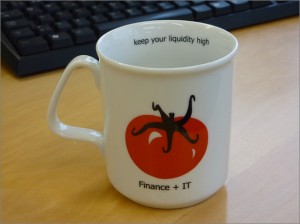
Die Tomato Tassen nahmen auch dieses Jahr wieder an der Structured FINANCE Veranstaltung in Karlsruhe vom 5./6. November teil. Bei der Veranstaltung handelt sich um den Kongress für moderne Unternehmensfinanzierung und strukturierte Finanzprodukte. Martin Schneider besuchte mit einer Tomato Kundin die Ausstellung.
Unsere Initiative mit den Tassen kam wieder sehr gut an und es freute mich persönlich sehr, Sie an der Messe mit einer Tomato Tasse zu sehen. Die Tasse steht nun sicher auf Ihrem Bürotisch.
Anforderungen für operationelle Risiken bei Banken
Am 1. Okt. publizierte die eidg.
Finanzmarkaufsicht FINMA die endgültige Fassung des teilrevidierten Rundschreibens "Operationelle Risiken Banken".
Darin konkretisiert sie die qualitativen Anforderungen ans Management von
operationellen Risiken und den Umgang mit elektronischen Kundendaten. Das Rundschreiben tritt am 1.
Januar 2015 in Kraft.
Medienmitteilung…
Rundschreiben…
Im KPMG Blog “Operationelle Risiken – Im Fokus der Regulatoren” erklärt Reto Gareus, was für Banken bei der Umsetzung wichtig ist. Blog…
EMIR: ESMA gibt Transaction Repositories bekannt
Die ESMA hat am 3. Nov. vier Melderegister (Trade Repositories) autorisiert. Somit starten die Melderegister zum 12. Februar 2014. Die vier TR sind:
- DTCC Derivatives Repository Ltd. (DDRL), based in the United Kingdom
- Krajowy Depozyt Papierów Wartosciowych S.A. (KDPW), based in Poland
- Regis-TR S.A., based in Luxembourg
- UnaVista Ltd, based in the United Kingdom
Pressemitteilung in Englisch...
Pre-Test des neuen UBS Online Banking
UBS wird ab Ende November ihr neues Online Banking etappenweise einführen. Prof. Dr. Andreas Dietrich von der Hochschule Luzern hat das neue UBS e-Banking getestet.
Im Blog “Das neue UBS Online Banking im Pre-Test” stellt er das neue e-banking vor, weist auf einige interessante Neuerungen hin und beschreibt seine persönlichen Erfahrungen. Die Änderungen sind mit screen shots dargestellt.
Prof. Dr. Dietrich fasst zusammen, was er am neuen Online Banking gut findet. Generell sei es ein “schöner und ziemlich grosser Schritt in die richtige Richtung.” Was er jedoch persönlich vermisst ist die Möglichkeit zur Interaktion via Video Chats oder Videoberatung. Blog…
Deutsche Bank Launches New Cash Management Structures in Asia Pacific
Press release Nov. 4, 2013- Deutsche Bank launched their “Payments and Collections On-Behalf-Of” program for corporate clients in Asia Pacific. The program is part of its Next Generation Treasury Solutions. “Payments-on-behalf-of (‘POBO’) and Collections-on-behalf-of (‘COBO’) are structures designed to help corporate treasuries to further optimise their cash management operations and liquidity,” the press release states.
These structures allow corporates to consolidate transactions and “their underlying cash flows through a streamlined bank account structure, enabling them to better manage their liquidity with increased visibility and control.”
"By leveraging our strong product platform and our consultative approach, we are able to help our clients perform the legal due diligence on their corporate cash management structures, which is key to ensuring a successful implementation,” explained Mahesh Kini, Asia Pacific Head of Cash Management for Corporates, Global Transaction Banking at Deutsche Bank. Press Release…
SEPA Means Reduction of Bank Partners
At the International Cash and Treasury Management Conference, hosted by EuroFinance in Barcelona, delegates discussed among a host of issues SEPA. Not only are many treasurers concerned with the impending deadline for transitioning to the new SEPA standard, they also said that the “the projects are a lot more complicated than people originally thought.”
The finding that “SEPA is driving many companies to decrease the number of banks they work with in a region,” is not surprising. We at Tomato have been saying this for long time.
Find information on SEPA and the bank issue in Martin Schneider’s presentation at the SEPA Workshop in London, February 2013. In this workshop, Martin Schneider talked with 40 participants how to implement the European payment initiative SEPA with as few resources as possible by
- planning first
- optimizing processes
- reducing bank channels and
- connecting electronically to the house banks, then by
- paying efficiently,
- receiving reports, and finally
- reducing fees with SEPA.
We've been suggesting to go live by 31 Oct 2013! (Nov as reserve month, Dec holidays, Jan too close to Feb!)
On
our website: SEPA-Time to Act
Presentation
at the Conference (22 pgs, pdf)
As Renminbi Becomes a Common Treasury Management
Currency, Bank Support Is Crucial
As result of China’s currency internationalization plans, transactions
in renminbi (RMB) are on the way of becoming a common treasury management
currency. That’s why corporates need to make sure that their bank is offering
the service they need to realize opportunities.
In the GTNews article “The Evolving Renminbi: A Treasury Management Currency Contender”, Joe Ng of Deutsche Bank explains the development of RMB internationalization and how it impacts corporates. He highlights four key elements that reveal banks’ commitment to help treasurers understand how to use the currency. Banks must:
- Maintain a position at the forefront of RMB developments, in China as well as abroad,
- Share their expertise,
- Offer “a holistic suite of cash, trade and FX products and services across the Renminbi spectrum that are seamlessly integrated, and providing clients with one-stop, streamlined access to practical advice and assistance,”
- Establish a global markets footprint.
Essentially,
banks must help corporate treasurers recognize the advantages of using the
renminbi “and then provide full support and guidance for their RMB transaction
needs across the globe,” asserts Joe Ng.
Full
story… (registration required, free)
Analyse von CIOs der Schweizer Top-Unternehmen –
Insights
from Accenture’s fourth High Performance IT research
Hansjörg Buchser, Lead Technology Schweiz bei Accenture, hat im computerworld.ch Artikel “Die Königsklasse der CIOs” die Erkenntise von “Insights from Accenture’s fourth High Performance IT research” zusammengefasst. Die Analyse zeigt dass CIOs eine digitale Vision und ein neues, persönliches Rollenprofil brauchen, um ihre Unternehmen optimal aufstellen können. Der Befund der Studie:
Erfolgreiche CIOs’ vier Stärken:
- Gesteigerte Innovationsfähigkeit
- Zielgerichtete Kooperationen
- Operative Exzellenz
- Finanzielle Feuerkraft
Drei Bereiche, in denen selbst diese CIOs noch aufholen könnten:
- Investitionen in Wachstumsmärkte
- Diversifikation der Exportrisiken
- Konsequente Digitalisierung
Basiert auf diesen Stärken und Schwächen beschreibt Herr Buchser die Aufgaben des CIOs. Demnach muss dessen Rolle in den drei Dimensionen Integration, Intelligence und Innovation verstärkt werden. Für die drei Dimensionen skizziert Herr Buchser drei neue Berufsprofile.
Es ist ausserdem “absolut erforderlich, dass der CIO
in der Geschäftsleitung des Unternehmens verankert ist und dort eine
gestaltende und treibende Rolle einnimmt,” sagt Herr Buchser.
Computerworld.ch
Artikel…
Accenture published its “Insights from Accenture’s fourth High Performance IT research” in a 44-page pdf document titled “High Performers in IT Defined by Digital – High Performance Delivered”.
What Do IT Project Managers Wish Most?
IT project managers’ top wishes, as explained by Jennifer Lonoff Schiff, a contributor to CIO.com, in her article 7 Top Wishes of IT Project Managers include:
- To be involved from project inception.
- To be able to put - and keep - together the perfect team for each project.
- To have powerful yet simple-to-use project management tools.
- To have clearly defined project objectives and requirements.
- To get buy-in from stakeholders and end-users.
- To be treated with respect.
- To be allowed to adjust projects as needed (without being second-guessed).
If you are the boss of an IT manager, find out what he/she needs and see what you can do to make him more effective. If you are an IT project manager, are your top wishes the same? If you have different wishes, share them with us. If you work with project managers, find out what you can do to make him/her more effective. After all, everybody involved wants the project to succeed.
Details to each of these wishes …
From the Desk of Regula Spottl, Greensboro, North Carolina
“Follow Your Passion” May not be a Good Strategy for Success
For years, I have believed leaders whose career advice is “Follow your Passion.” It made sense. Why do something for which you have no passion!
Scott Adams, the creator of Dilbert cartoons talked in a recent Wall St. Journal essay about success and failure. Apparently, all this adult life, he drew lessons, skills and ideas from failures which helped him to the success he has achieved.
Adams explains that “Follow your passion” is a reasonable argument: It gives you “high energy, high resistance to rejection and high determination. Passionate people are more persuasive, too.”
Well, his counterargument is just as persuasive. Adams recalls that when he was a commercial loan officer for a large bank, his boss taught to never make a loan to someone who is following his passion. For example, “never give money to a sports enthusiast who is starting a sports store to pursue his passion for all things sporty. That guy is a bad bet, passion and all. He's in business for the wrong reason.”
Adams’ boss, who had been a commercial lender for over 30 years, said that the best loan customer is someone who has no passion whatsoever, just a desire to work hard at something that looks good on a spreadsheet.
This is worth thinking about! A lot of WSJ readers have and almost 150 of them commented on Adams’ story. Find out which arguments resonate with your experience in the article Scott Adams' Secret of Success: Failure